Refining Regions of Interest
A number of options, described below, are available in Dragonfly for refining regions of interest.
 Processing Islands
In cases in which you need to refine threshold segmentation results or need to isolate objects of a certain size, you can remove small objects from a region of interest, as well as isolate larger objects. These operations can be based on voxel counts or by rank.
Right-click a region of interest in the Data Properties and Settings panel and then choose Process Islands in the pop-up menu. You can then choose to remove or keep objects as described in the following table.
|
|
Description |
|---|---|
|
Remove (6-connected) |
Removes all objects, as determined by the 6-connected method, that have a voxel count lower than a selected threshold. Voxel counts can be selected in the Minimal Voxel Count dialog, shown below.
|
|
Isolate (6-connected) |
Keeps all objects, as determined by the 6-connected method, that have a voxel count higher than a selected threshold. Voxel counts can be selected in the Maximal Voxel Count dialog, shown below.
|
|
Remove (26-connected) |
Removes all objects, as determined by the 26-connected method, that have a voxel count lower than a selected threshold. Voxel counts can be selected in the Minimal Voxel Count dialog. |
|
Isolate (26-connected) |
Keeps all objects, as determined by the 26-connected method, that have a voxel count higher than a selected threshold. Voxel counts can be selected in the Maximal Voxel Count dialog. |
|
Remove (6-connected) |
Removes a selected number of the largest connected components, as determined by the 6-connected method and as ranked by voxel count*. For example, if 5 is selected as the threshold, then the largest 5 connected components will be removed from the selected region of interest. The number of components to remove can be selected in the Remove Biggest Count dialog, shown below.
|
|
Isolate (6-connected) |
Keeps a selected number of the largest connected components, as determined by the 6-connected method and as ranked by voxel count*. For example, if 12 is selected as the threshold, then all connected components except for the 12 largest will be removed from the selected region of interest. The number of components to retain can be selected in the Isolate Biggest Count dialog, shown below.
|
|
Remove (26-connected) |
Removes a selected number of the largest connected components, as determined by the 26-connected method and as ranked by voxel count*. The number of components to remove can be selected in the Remove Biggest Count dialog. |
|
Isolate (26-connected) |
Keeps a selected number of the largest connected components, as determined by the 26-connected method and as ranked by voxel count*. The number of components to retain can be selected in the Isolate Biggest Count dialog. |
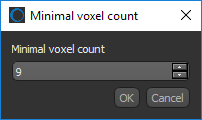
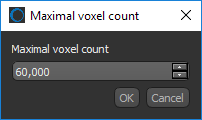
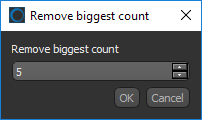
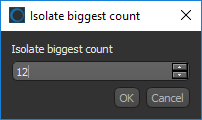
* Objects with an identical voxel count will be considered as unique objects when ranked.
Remove Voxels Below Local Center of Range
Lets you minimize beam hardening effects.
Fill Connected Pores with a Diameter Smaller Than
Lets you fill connected pores with an opening diameter smaller than the selected threshold. You should note connected pores are defined as segments that are connected to the borders of its volume. Holes and other enclosed segments are classified as non-connected and will not be filled.
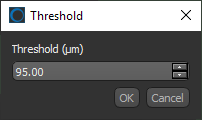
The opening diameter of the connected pores that you want to fill is selectable in the Threshold dialog, shown below. The output of this process is a new region of interest.
Threshold dialog
Remove Objects That Touch Another ROI or Multi-ROI
Automatically removes objects, which can be defined as groups of labeled voxels that are connected, within the current region of interest that intersect with a selected ROI or multi-ROI.
In the example below, the objects in the ROI with the orange circles that were touching the blue ROI were removed.

How to Remove Objects That Touch Another ROI or Multi-ROI
- Right-click the region of interest you need to modify and then choose Refine Region of Interest > Remove Objects That Touch Another ROI or Multi-ROI in the pop-up menu.
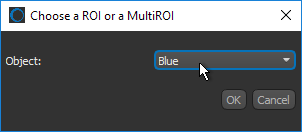
- Choose the ROI or multi-ROI that is touching parts of the region of interest that you are modifying in the Choose ROI or Multi-ROI dialog.
- Click OK.
Touching objects are removed automatically from the selected ROI.
Create ROI Using Neighbor Count
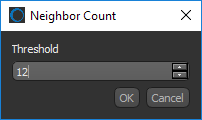
Creates a new region of interest that contains only labeled voxels with an original neighbor count greater than or equal to a selected threshold. Thresholds are selectable in the Neighbor Count dialog, shown below.
This option is often used in the topological analysis of skeletons.


